Tomographic Imaging: Portable Breast Tomosynthesis
Digital breast tomosynthesis (DBT) is the new standard of care for the screening and diagnosis of breast cancer. It provides higher accuracy, earlier detection, and reduced morbidity with radiation doses that are now approximately the same as conventional digital mammography. It is also better at imaging dense breasts. As a result, DBT now accounts for essentially all new mammography installations. This progress has come with a few drawbacks, however, including higher costs, artifacts from tube motion, and above all worsening disparities. Women in rural, inner city, tribal and other areas, as well as disabled women and female veterans have much lower access to this new standard of care, and unfortunately, these underserved women have the highest mortality from breast cancer. Mobile clinic outreach programs using “big pink buses”, make valiant efforts to serve them, but they are limited and very expensive.
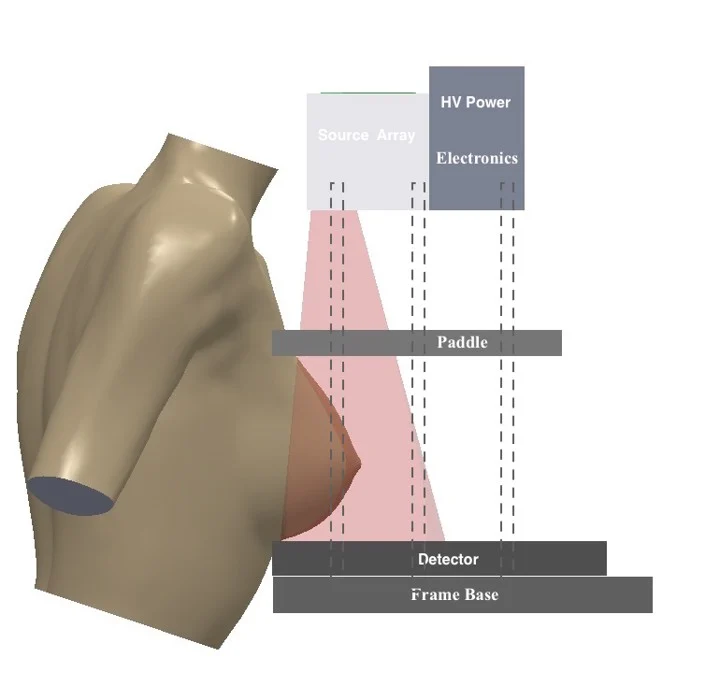
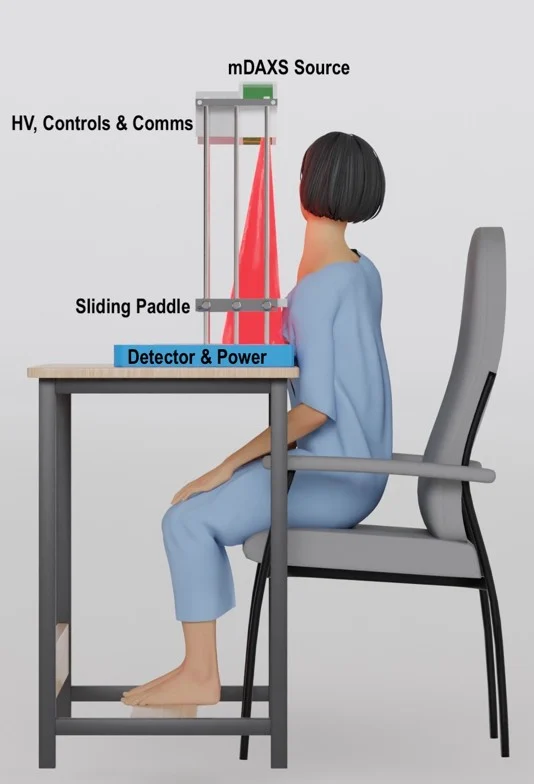
Stellarray has designed and partially prototyped a Portable Breast Tomosynthesis System (PBTS) that will weigh under 40 pounds, have 5% of the volume of conventional DBT systems, and cost less than half their price. PBTS will comprise a special DAXS x-ray source, an off-the-shelf detector, support brackets, base and power supply. It will fit into a small suitcase and and can be set up in 15 minutes virtually anywhere. The source has been designed for 13 or 25 projections, in line with industry standards, and the system will have image quality equivalent to the best conventional systems, and then a bit better due to the elimination of motion artifacts. When combined with AI and telemedicine links, it can change the way DBT is done for a lot of women in the United States and especially in less developed countries. PBTS will also be well-suited to imaging with the patient in the prone position and no breast compression.
Stellarray has developed the technology for cold cathodes emitting the current pulses needed for DBT in spot sizes already down to 0.25 mm. We have developed high voltage packaging technology for the source, as well as the required stray radiation shielding, vacuum sealing, integrated high voltage generation and controls, and on-board cooling using no fluids.